Why “Deeper” Isn’t Always Better When It Comes to Awning Projection
When homeowners think about improving shade, the instinct is often simple: go bigger. A deeper awning must mean more protection, right? In Arizona’s intense sun, it’s an understandable assumption, but it’s also one of the most common design mistakes.
In reality, awning performance depends far more on sun angle, height, slope and orientation than raw projection depth. An oversized awning can introduce new problems without meaningfully improving shade, especially in Phoenix, where wind, heat and seasonal sun paths all play a role.
Sun Angle Matters More Than Depth
The primary job of an awning is to intercept sunlight before it hits windows, walls or outdoor living areas. Whether it succeeds depends on where the sun is in the sky, not just how far the awning sticks out. In Arizona:
- Summer sun is high and steep
- Winter sun is low and angled
- Morning and afternoon sun comes in horizontally from the east and west
A very deep awning may block midday summer sun, but if it’s mounted too high or too flat, low-angle morning or afternoon sun will still slide right underneath it. In those cases, additional depth provides little benefit.
Oversized Projection Does Little Against Low-Angle Sun
Low-angle sun is the most difficult to control and the most overlooked.
East- and west-facing exposures are especially problematic. The sun sits low on the horizon, delivering glare and heat from the side rather than above. Simply extending an awning farther outward doesn’t change that geometry.
Without proper angle and orientation:
- Deeper awnings still allow side penetration
- Glare persists during mornings and late afternoons
- Interior heat gain continues despite larger shade structures
Designing for sun path is far more effective than adding depth alone.
Excessive Depth Increases Wind Load
In Phoenix and across the Valley, installing awnings that can withstand monsoon winds is important. Deeper awnings:
- Catch more uplift during gusts
- Experience greater lateral force
- Place increased stress on mounting points, frames and fasteners
Even a few extra feet of projection can dramatically increase wind load. Without proper engineering, this can lead to:
- Premature loosening of mounts
- Frame distortion
- Fabric damage or failure during storms
In extreme cases, oversized awnings become liabilities rather than assets.
Improper Projection Can Cause Heat Trapping
More shade doesn’t always mean cooler performance.
When an awning extends too far without adequate airflow consideration, it can trap hot air against walls and windows. Instead of allowing heat to rise and dissipate, the awning creates a pocket of stagnant air. This can:
- Increase wall surface temperatures
- Reduce cooling efficiency
- Make covered patios feel warmer, not cooler
Balanced projection allows shade and ventilation.
Structural Limits
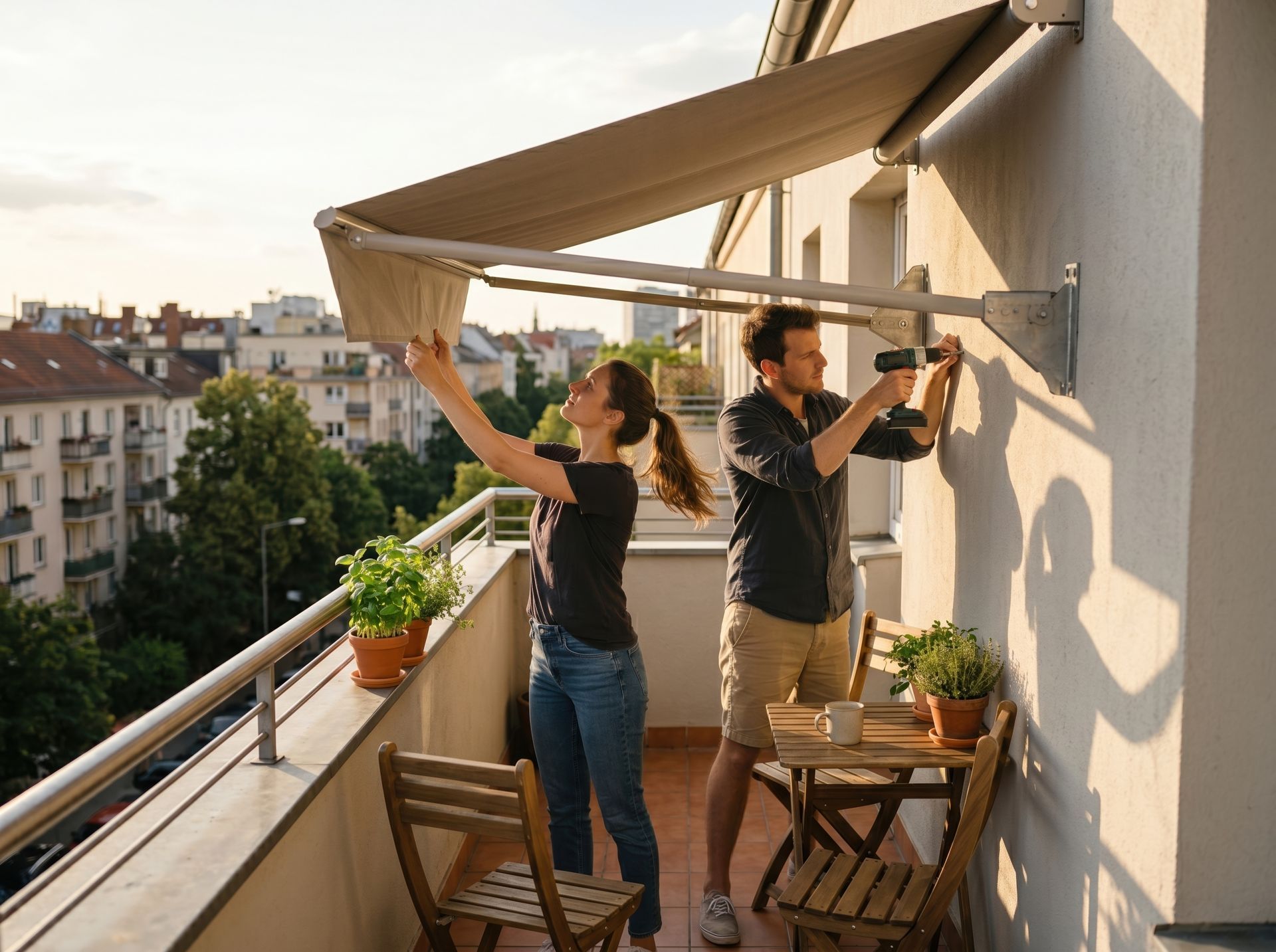
Larger projections demand more from the structure supporting them. As depth increases:
- Heavier hardware is required
- Additional brackets or supports may be necessary
- Wall framing limitations become critical
If these factors aren’t addressed during design, durability suffers. An awning that looks impressive on paper may struggle long-term if the structure wasn’t engineered for the load.
This is especially important for retrofits on older homes or storefronts where wall construction varies.
Deeper Awnings Can Reduce Usable Space
Bigger isn’t always better for how a space functions. Excessive projection can:
- Interfere with walkways
- Block sightlines from windows or doors
- Create clearance issues in patios or commercial entries
- Limit outdoor circulation and flexibility
In tight patios or storefront settings, oversized awnings can feel intrusive rather than helpful. Good shade design enhances usability; it shouldn’t get in the way of how people move and interact with the space.
Fabric Wear Accelerates at the Leading Edge
From a longevity standpoint, deeper awnings face another issue: fabric stress. Longer extensions increase:
- Sag at the front bar
- Tension at attachment points
- Flapping and movement during wind events
Over time, this accelerates wear at the leading edge, the area most exposed to UV, wind and tension. The result is a shorter fabric lifespan and more frequent replacements. A properly sized awning maintains even tension and performs better over years of use.
Balanced Design Performs Better Long-Term
The most effective awnings aren’t defined by maximum projection; they’re defined by proportion. Proper projection is a ratio based on:
- Mounting height
- Window or opening size
- Sun orientation
- Awning slope and angle
- Local wind conditions
There is no universal “best depth.” A balanced design tailored to the specific exposure consistently outperforms oversized, one-size-fits-all solutions.
Smarter Shade Starts With Smarter Design
Arizona Awnings specializes in high-end custom awning solutions designed around sun angles, wind exposure and long-term performance. We focus on balanced projection, proper engineering and real-world durability, not unnecessary oversizing.
Contact us at 602-252-3430 to request a free on-site awning design and installation estimate.